
Champagne und Bretagne
Ein Reisebericht
Champagne und Bretagne – Ein Reisebericht
Früher Start um 5.15 Uhr in Göppingen. Karlsruhe, Straßburg – und dann Frankreich. Die Straßen weitgehend leer, der Verkehr ruhig. Auffällig schnell: klare Tempolimits, an die sich die Franzosen erstaunlich konsequent halten. Das nimmt Tempo raus, aber auch Stress. Die Mautstellen laufen nebenbei – Kreditkarte oder Smartphone, kein Anhalten, kein Aufwand.
In der Champagne öffnet sich die Landschaft. Große, leuchtend gelbe Rapsfelder, dazu die erste spürbare Vorfreude auf das, worum es hier geht: Champagner direkt vor Ort.
Ankunft im Château d’Étoges. Großzügig, ruhig, stimmig. Kein überladener Luxus, sondern ein Haus mit Haltung. Ein Glas Champagner, Ziegenkäse, frisches Baguette – einfach, klar, genau richtig. Benny ist sofort angekommen. Wir auch.
Der Abend setzt direkt den Ton: sechs Gänge, begleitet von unterschiedlichen Champagnern. Ohne große Inszenierung, dafür mit viel Präzision. Besonders der Service fällt auf – ruhig, aufmerksam, perfekt im Ablauf.
Am nächsten Morgen Weinberge, dann Champagnerprobe. Kein Experte geworden, aber deutlich näher dran. Die Juniorchefs eher verhalten, die Seniorchefin übernimmt souverän. Unser Französisch mit Patina, aber es funktioniert. Sechs Flaschen wandern in den Kofferraum – man denkt ja voraus.
Am Nachmittag einige bekannte Champagnerhäuser, beeindruckend, aber erwartbar. Mehr hängen bleiben die weiten Rapsfelder und die kleinen Höfe dazwischen. Abends Brasserie, unkompliziert gut – natürlich wieder mit Champagner.
Am 20.04. weiter Richtung Bretagne. Südroute an Paris vorbei, viel Verkehr, rund sieben Stunden bis Ploumanac’h. Der Grund für volle Rastplätze und zähen Verkehr folgt später: Pariser Ferien bis Anfang Mai.
Ankunft im Hotel Beau Site. Sehr gutes Niveau, klar organisiert, serviceorientiert, ohne steif zu wirken. Zimmer mit Blick auf Meer und Granitküste. Das Abendessen: kreativ, fein, präzise.
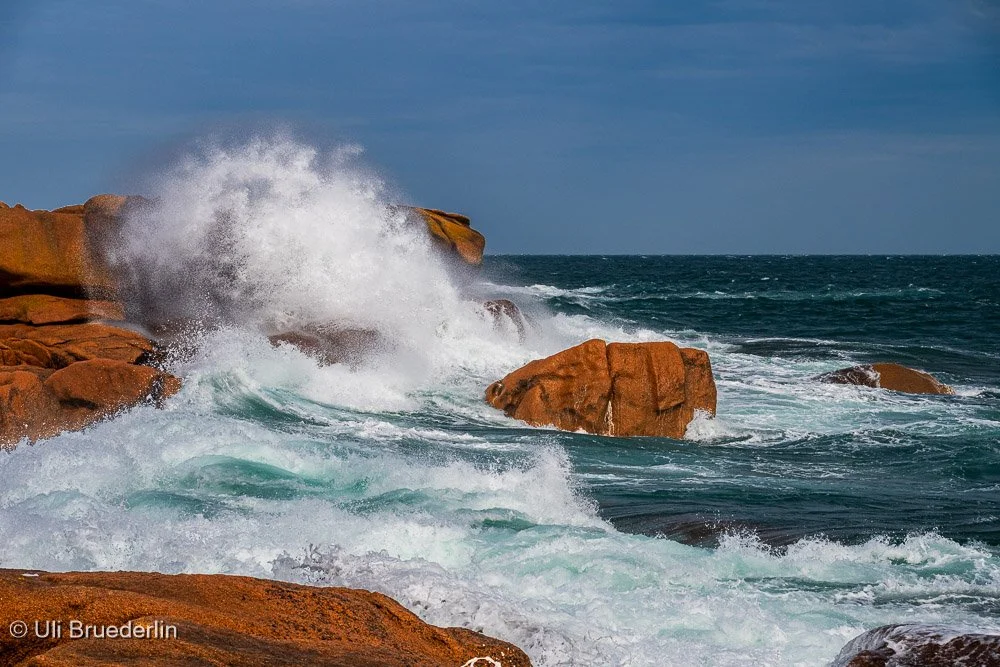
Die nächsten Tage bestimmen Wind, Küste und Kamera den Rhythmus. Rosa Granitküste, Île Renote, Île Grande, Maison du Gouffre, Cap Fréhel – viel Bewegung, starke Farben, dramatisches Licht. Windstärke 8, Ebbe, Segelboote auf dem Trockenen, blühender Ginster, alte bretonische Häuser aus Stein, dazwischen erstaunlich viele Blumen. Die Bretagne wirkt rau, aber nie karg.
Schnell wird klar: Wer fotografieren will, muss früh raus. Nach 10.00 Uhr gehören die guten Spots den Franzosen. Ferien eben. Dafür entstehen morgens die besseren Bilder – und gelegentlich auch die besseren Begegnungen, etwa mit einem deutschen Fotografen, der kurzerhand Stativ und Filter verleiht.
Kulinarisch bleibt das Niveau auffallend konstant. Crêperie, Galette, Cidre, Brasserie, Fisch, Lobster, Seebrasse im Salzmantel – selbst dort, wo es schlicht bleibt, bleibt es gut. Und dort, wo es ambitioniert wird, oft erstaunlich präzise. Das gilt für Beau Site ebenso wie später für das Hotel La Plage in Plonévez-Porzay.
Der Wechsel nach Plonévez-Porzay bringt noch einmal ein anderes Niveau. Schon die Ankunft im Hotel La Plage: Lage, Empfang, Service – außergewöhnlich gut. Das setzt sich fort. Küche, Weinauswahl, Timing – über Tage bemerkenswert konstant. Man gewöhnt sich erschreckend schnell daran.
Dazwischen: Leuchttürme, Fischereihäfen, Schiffsfriedhöfe und spektakuläre Küsten. Île Vierge morgens im Nebel. Cap de la Chèvre mit weitem Blick und viel Wind. Point de Pen-Hir mit dramatischer Küstenlinie. Phare d’Eckmühl mit 290 Stufen und einem Blick, der jede Mühe rechtfertigt. Penmarc’h zeigt die harte Seite der Küste – alte Kutter, Arbeit, Salz, Gebrauchsspuren. Douarnenez dagegen wirkt weicher, fast filmreif, mit alten Häusern, Booten und genau der richtigen Portion Patina.
Zum Schluss noch Pointe du Van, Pointe du Raz und ein Stopp in Locronan – ein Ort fast zu schön, um echt zu sein. Ein wenig Schokolade, bretonisches Bier, ein paar Mitbringsel. Danach ein letztes Dinner, zum Abschluss ein Grand-Marnier-Soufflé, das jeden guten Vorsatz zuverlässig beendet.
Dazwischen immer wieder Benny. Am Strand, im Hotel, auf langen Wegen, bei Wind, Ebbe und Abendrunden. Vollkommen entspannt. Dabei sein ist alles.
Am 1. Mai beginnt der Rückweg mit Zwischenstopp in der Domaine de Vaugouard, am 2. Mai nach weiteren 600 Kilometern zurück in Göppingen.
Zwei Wochen Frankreich liegen hinter uns – erst Champagne, dann Bretagne. Sehr guter Champagner und eine bemerkenswert konstante Serie exzellenter Abendessen. Kulinarisch war das kein Urlaub, eher ein Trainingslager. Jetzt bleibt nur die Frage, ob ein normales Abendessen ohne Champagner und ohne diese feine, präzise und erstaunlich mühelose Küche künftig überhaupt noch denselben Zauber entfalten kann.
Was ebenfalls bleibt: fast zwei Wochen Sonne ohne einen einzigen Regentag, saubere Straßen, gepflegte Orte, diszipliniertes Fahren und eine angenehme Gelassenheit, die das Reisen in Frankreich erstaunlich entspannt macht.
Champagne and Brittany
A travel journal
Champagne and Brittany – a travel journal
An early start at 5:15 a.m. in Göppingen. Karlsruhe, Strasbourg – and then France. The roads were largely empty, the traffic calm. One thing became obvious very quickly: clear speed limits, and the French actually stick to them. It slows things down, but removes most of the stress. Toll stations are equally uncomplicated – credit card or smartphone, no stopping, no drama.
In Champagne the landscape begins to open up. Vast fields of glowing yellow rapeseed, and with them the first real sense of anticipation for what brought us here in the first place: Champagne at its source.
Arrival at Château d’Étoges. Spacious, calm, elegant. Not overdone luxury, but a place with character. A glass of Champagne, goat cheese, fresh baguette – simple, precise, exactly right. Benny settled in immediately. So did we.
That evening immediately set the tone: six courses paired with different Champagnes. No grand staging, just precision. What stood out most was the service – calm, attentive and perfectly timed.
The next morning began in the vineyards, followed by a Champagne tasting. I did not become an expert, but I certainly came closer. The younger hosts were somewhat reserved, while the senior hostess took over with confidence and charm. Our French had aged about fifty years, but somehow it still worked. Six bottles ended up in the trunk – one likes to be prepared.
In the afternoon we visited several of the well-known Champagne houses. Impressive, certainly, but also somewhat expected. What stayed with us more were the endless rapeseed fields and the small, modest farms in between. Dinner that evening in the brasserie: relaxed, straightforward, very good – naturally with Champagne again.
On April 20th we continued toward Brittany. South of Paris, plenty of traffic, around seven hours to Ploumanac’h. The reason for the crowded rest stops and slow traffic became clear later: Paris was on holiday until early May.
Arrival at Hotel Beau Site. Very good level, well organized, service-oriented without ever feeling stiff. A room overlooking the sea and the granite coast. Dinner: creative, elegant, precise.
The following days were shaped by wind, coastline and camera. The Pink Granite Coast, Île Renote, Île Grande, Maison du Gouffre, Cap Fréhel – constant movement, strong colors and dramatic light. Wind force 8, low tide, sailboats resting on dry sand, blooming gorse, old Breton stone houses and unexpectedly many flowers. Brittany feels rugged, but never barren.
It quickly became clear: if you want good photographs, you have to get out early. After 10 a.m., the best spots belong to the French. School holidays. The reward is better light, better images and occasionally better encounters – such as the German photographer who casually lent me his tripod and filter.
Culinarily, the standard remained remarkably high. Crêperies, galettes, cider, brasseries, fish, lobster, sea bream baked in salt crust – even when simple, it was good. And when ambitious, often surprisingly precise. That applied to Beau Site and even more so later at Hotel La Plage in Plonévez-Porzay.
The move to Plonévez-Porzay raised the level again. Arrival at Hotel La Plage: location, welcome and service – exceptional. And it stayed that way. Kitchen, wine list and timing remained consistently strong over several days. One adapts to that alarmingly quickly.
In between: lighthouses, fishing harbors, ship graveyards and spectacular coastlines. Île Vierge in the morning mist. Cap de la Chèvre with wide views and strong wind. Point de Pen-Hir with dramatic cliffs. Phare d’Eckmühl, 290 steps and a view worth every one of them. Penmarc’h showed the harsher side of the coast – old trawlers, hard work, salt and wear. Douarnenez felt softer, almost cinematic, with old houses, boats and exactly the right amount of patina.
Toward the end: Pointe du Van, Pointe du Raz and a stop in Locronan – a village almost too perfect to be real. A little chocolate, Breton beer and a few small gifts. Then one final dinner, ending with a Grand Marnier soufflé that put an end to every remaining good intention.
And throughout it all, Benny. On the beach, in the hotels, on long walks, in wind, low tide and late evening strolls. Completely relaxed. Being there was enough.
On May 1st the return journey began with one overnight stop at Domaine de Vaugouard. On May 2nd, after another 600 kilometers, back in Göppingen.
Two weeks in France behind us – Champagne first, then Brittany. Excellent Champagne and a remarkably consistent run of outstanding dinners. Culinarily, this was less a holiday than a training camp. The only real question now is whether an ordinary dinner, without Champagne and without that fine, precise and seemingly effortless cuisine, can ever quite cast the same spell again.
What also remains: almost two weeks of sunshine without a single day of rain, clean roads, well-kept towns, disciplined driving and a quiet ease that makes traveling through France surprisingly relaxing.